Work 03 / 11Research
Posters
Generative models that design molecules for mutant p53
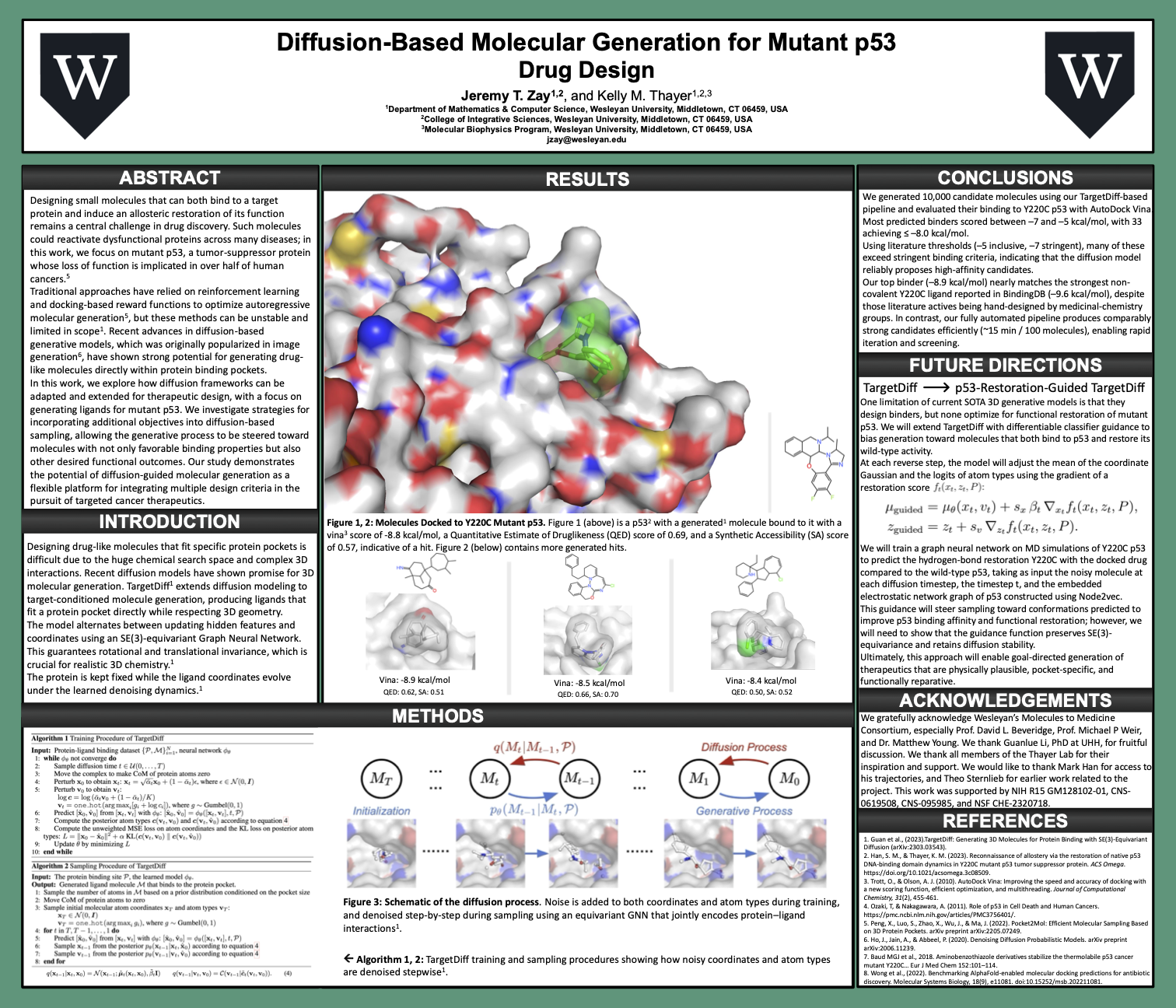
Diffusion
I used diffusion models to generate drug-like molecules that bind to the Y220C mutant of p53, and presented the work at the ACS Nerd Conference and the Wesleyan Biophysics Retreat.
This poster uses diffusion models to generate molecules conditioned on a protein structure. SE(3)-equivariant networks, pocket-aware conditioning and guided sampling push generation toward molecules predicted to bind the Y220C variant of p53. A diffusion model can take in the protein's spatial features and optimize chemical properties while it samples, and the poster argues that this beats tuning with reinforcement learning for targeted drug design.
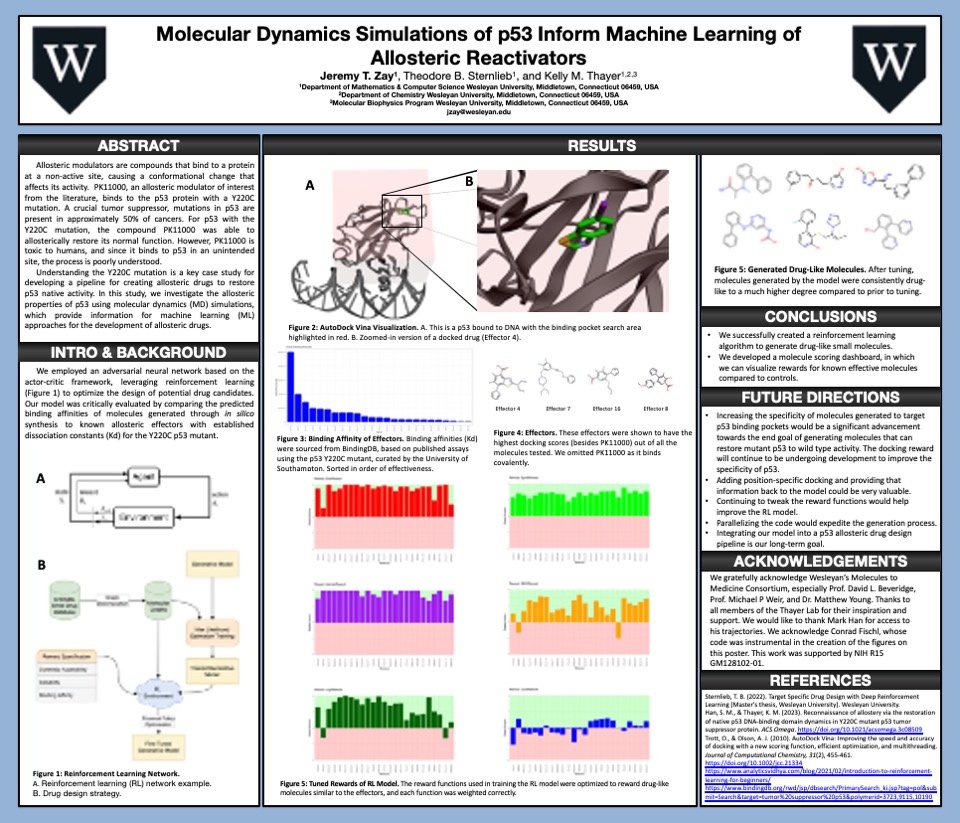
Reinforcement Learning
I used reinforcement learning fine-tuning to generate molecules that bind to mutant p53, and presented the poster at the UC Merced Mercury Conference and the Wesleyan Biophysics Retreat.
This poster describes a reinforcement learning setup for generating small molecules, guided by molecular dynamics simulations of the p53 Y220C mutant. Structural information from the simulations, docking-based rewards and an actor-critic model steer generation toward allosteric effectors that bind well. The question behind it is whether feedback from how the protein moves can shape a molecule-design policy and help reactivate the mutant allosterically.